Text-to-SQL for Large Databases: Why Schema Pruning Matters
AI Text-to-SQL tools often fail on large databases because the full schema overflows the model's context or buries the relevant tables in noise. Schema pruning selects only the tables and relationships a question needs, so the model can generate accurate SQL on schemas with thousands of tables.
A Text-to-SQL demo on a small sample database looks effortless. Ask a question, get a query, see the answer. The picture changes the moment the same tool meets a real enterprise database with hundreds or thousands of tables.
This is where many AI analytics tools quietly break. The cause is rarely the model's SQL skills. It is the schema: too much of it, with too little guidance about which parts matter. This article explains why large schemas defeat Text-to-SQL, how schema pruning solves the problem, and how ZeroQueries approaches it.
Why Large Schemas Break Text-to-SQL
Context overflow. To write SQL, a model needs to see the schema. A schema with thousands of tables and tens of thousands of columns may not fit in the model's context window at all.
Distracting noise. Even when everything fits, hundreds of irrelevant tables compete for the model's attention, which can reduce accuracy.
Invented joins. When the right relationships are buried, a model may guess at joins or columns that do not exist.
Cost and latency. Larger prompts take longer and cost more on every single question.
Hard-to-read structures. Enterprise systems, ERP platforms especially, often use terse or coded table and column names that give the model little to work with.
What Schema Pruning Does
Schema pruning, also called schema linking, selects only the tables and columns relevant to a question before any SQL is generated. Instead of handing the model the entire database, the system hands it a small, focused slice.
A typical pruning flow looks like this:
Index the metadata. Table names, columns, relationships, and business meanings are catalogued in advance.
Match the question. The system ranks which parts of the schema the question is about.
Follow the relationships. It adds the bridge tables needed to connect the relevant ones.
Generate SQL. The model writes the query using only that focused context.
Why Foreign-Key Traversal Matters
Picking the right tables is not enough. Real questions cross several tables, and the connections between them often pass through intermediate tables the question never mentions.
Consider "Which customers have unpaid invoices, grouped by region?" The answer may need customers, invoices, payments, and a region table, joined through keys and bridge tables. If pruning drops a bridge table, the join breaks, and the model either fails or invents a path.
That is why good pruning follows foreign-key relationships across multiple hops rather than just matching keywords to table names.
From Thousands of Tables to Three
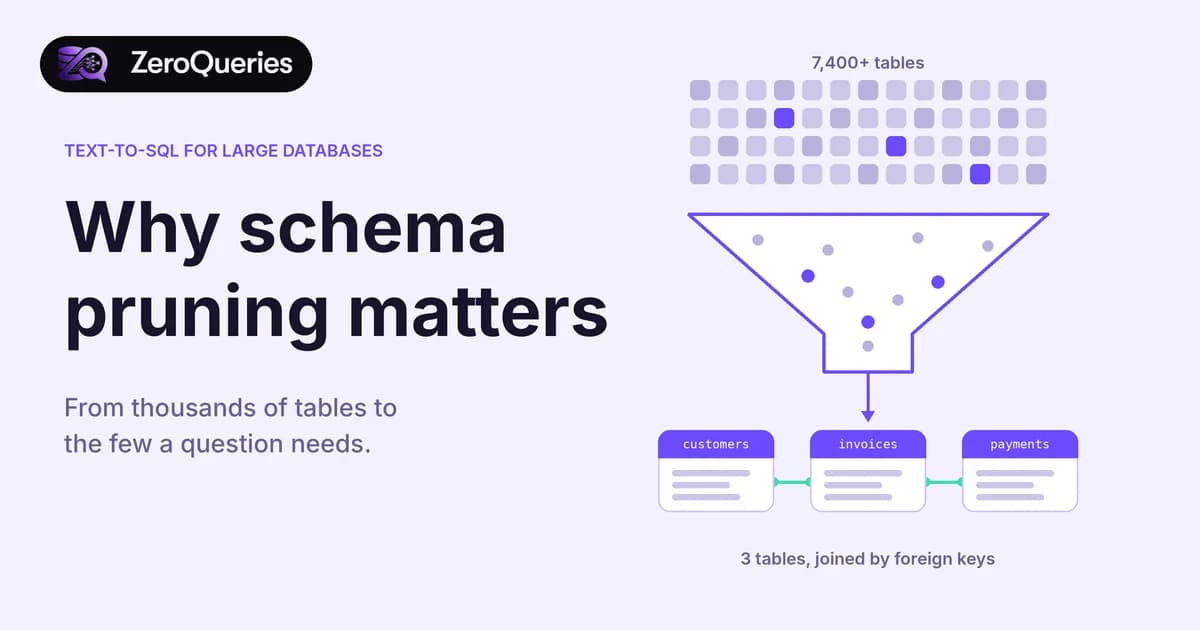
In practice, the result is a dramatic reduction. A database with more than 7,000 tables might need only three of them to answer a given question. Passing those three tables, with their relationships and business definitions, gives the model a clear, small problem to solve instead of an impossible one.
Pruning Improves Accuracy; Validation Keeps It Safe
Schema pruning and SQL validation do different jobs. Pruning helps the model write the right query. Validation makes sure that whatever query it writes is safe to run, for example by rejecting INSERT, UPDATE, DELETE, DROP, and ALTER statements before they reach the database. A production system needs both.
How ZeroQueries Approaches Enterprise Schema Scale
ZeroQueries indexes database metadata into a semantic graph and dynamically prunes irrelevant schema, so only the few tables a question needs reach the model. It is designed for large environments such as Oracle EBS, with more than 7,000 tables, and follows foreign-key relationships across multiple hops to assemble the right joins.
From there, a deterministic AST parser validates every generated statement, and queries run as read-only SELECT statements on a dedicated replica, with row-level security and PII masking and no copying of your data. ZeroQueries connects to Oracle, PostgreSQL, MySQL, Snowflake, and MongoDB.
See more on the Enterprise Schema Traversal page.
Questions to Ask Any Text-to-SQL Vendor About Scale
How many tables and columns has it been used with in practice?
How does it choose which tables to show the model?
Does it follow foreign keys across multiple hops, including bridge tables?
How does it handle terse or coded column names and company-specific terms?
Is every generated query validated before execution?
Does your data stay inside your environment?
Conclusion
Text-to-SQL does not fail on large databases because AI cannot write SQL. It fails because the model is asked to find a few tables in a sea of thousands. Schema pruning with foreign-key traversal turns that impossible search into a small, solvable one, and validation makes sure the result is safe to run.
That combination is what lets conversational analytics work on real enterprise data. Explore ZeroQueries to see how it handles your own schema.
Frequently Asked Questions
A large schema can overflow the model's context window, or fill it with irrelevant tables that distract the model. Both lead to wrong tables, invented joins, and inaccurate SQL.
Turn Plain English into Verified Relational Analytics in Seconds
ZeroQueries connects directly to PostgreSQL, Oracle, and enterprise schemas with zero data movement, guaranteed 100% read-only safety, and automated interactive charts.