ChatGPT for Database: From Questions to Database Queries
ChatGPT for database means asking questions in plain language and getting answers from your own live data. ZeroQueries does this by finding the right tables, generating SQL, validating it with a deterministic AST parser, and running it read-only, so teams get answers without writing queries or moving data.
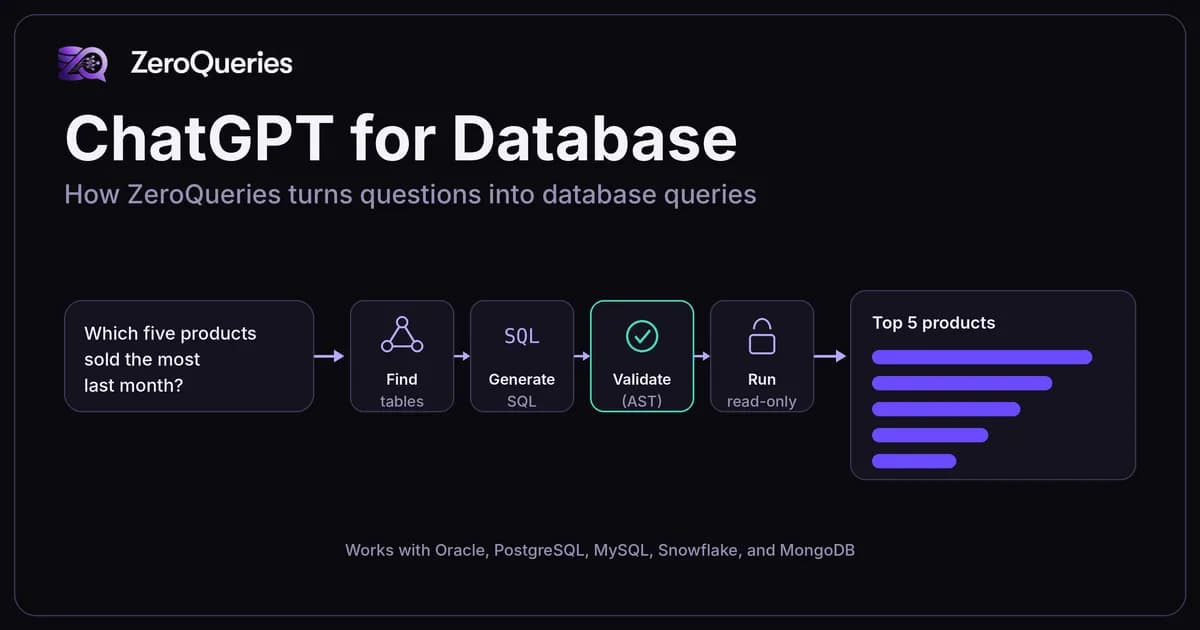
How ZeroQueries Turns Questions into Database Queries
Many people already ask ChatGPT for help with writing, research, and code. A natural next question is whether you can ask your own database questions the same way.
"ChatGPT for database" describes that experience: asking a question in plain language and getting an answer from your own live data, without writing SQL. This article explains what that really requires, why a general-purpose chatbot is not enough, and how ZeroQueries turns questions into validated database queries.
What "ChatGPT for Database" Really Means
It means a natural language interface to your data. A user types a question, the system translates it into a database query (Natural Language to SQL, or Text-to-SQL), runs it, and returns the result as an answer, a table, or a chart.
The "ChatGPT" part is the conversation. The "database" part is what makes the answers specific to your business. Both matter: a conversation without your data is generic, and your data without a conversation still needs an analyst to unlock it.
Why a General-Purpose Chatbot Is Not Enough
It does not know your schema. It cannot see your table names, relationships, or business definitions, so it guesses.
It cannot reach your live data safely. Copying exports into a chat is manual, quickly outdated, and can move sensitive information outside your environment.
Nothing validates its SQL. Generated queries can be invalid, inefficient, or unsafe, with no check before they run.
It cannot enforce your access rules. Row-level permissions and masking of personal data must be applied where the data lives.
How ZeroQueries Turns Questions into Database Queries
1. Understand the question. Users ask in English or Arabic, using their own business language.
2. Find the right tables. ZeroQueries indexes database metadata into a semantic graph and prunes irrelevant schema, so only the few tables a question needs reach the model, even in databases with more than 7,000 tables.
3. Generate SQL. Using that context, it follows foreign-key relationships across tables to build the right joins.
4. Validate before running. A deterministic AST parser inspects every statement and rejects INSERT, UPDATE, DELETE, DROP, and ALTER before they reach the database connection pool.
5. Execute safely. Queries run as scoped, read-only SELECT statements on a dedicated replica, with row-level security and PII masking. Your data is not copied or moved out of your environment.
6. Answer in context. Users receive SQL-backed answers, tables, and charts, and can ask follow-up questions.
An Example
A user asks: "Which five products had the highest sales last month?" Behind the question, a query like the following is generated, validated, and executed. It is illustrative; the actual SQL depends on your schema.
SELECT product, SUM(sales) AS total_sales
FROM orders
WHERE order_date >= DATE_TRUNC('month', CURRENT_DATE - INTERVAL '1 month')
  AND order_date <  DATE_TRUNC('month', CURRENT_DATE)
GROUP BY product
ORDER BY total_sales DESC
LIMIT 5;
The user never writes this query. They read the answer.
Works With the Databases You Already Run
ZeroQueries connects directly to Oracle, PostgreSQL, MySQL, Snowflake, and MongoDB, so teams can ask questions of the data they already have rather than migrating it.
Who Benefits
Business teams get answers without waiting for a report.
Analysts spend less time on routine requests and more on complex analysis.
Data and engineering teams keep control over access and schema.
Security teams get read-only access, validation, and masking by design.
What to Look For in Any "ChatGPT for Database" Tool
Schema awareness, not just generic SQL generation
Deterministic validation of every query before execution
Read-only access and role-based or row-level permissions
Data that stays in your environment
Support for the languages your teams use
Answers you can verify against the underlying query
Conclusion
The appeal of "ChatGPT for database" is simple: ask a question, get an answer from your own data. Delivering it responsibly takes more than a chatbot. It takes schema understanding, validated SQL, read-only execution, and access controls working together.
That is the approach ZeroQueries takes. See how it works on the ZeroQueries Text-to-SQL page, or explore ZeroQueries to try it on your own data.
Frequently Asked Questions
A general-purpose chatbot does not know your schema and cannot safely connect to your live data. A purpose-built tool such as ZeroQueries connects to your database, understands its structure, validates the SQL it generates, and runs it read-only.
Turn Plain English into Verified Relational Analytics in Seconds
ZeroQueries connects directly to PostgreSQL, Oracle, and enterprise schemas with zero data movement, guaranteed 100% read-only safety, and automated interactive charts.