Beyond Traditional Dashboards: How Conversational AI Is Transforming ERP Data Access
Conversational AI simplifies ERP data access by enabling employees to retrieve business insights using natural language through Slack, WhatsApp, and REST APIs. Instead of navigating complex dashboards or writing SQL queries, users can ask questions and receive relevant information directly. Combined with read-only SQL enforcement, AST validation, and role-based access control, this approach delivers a more intuitive and secure way to access enterprise data.
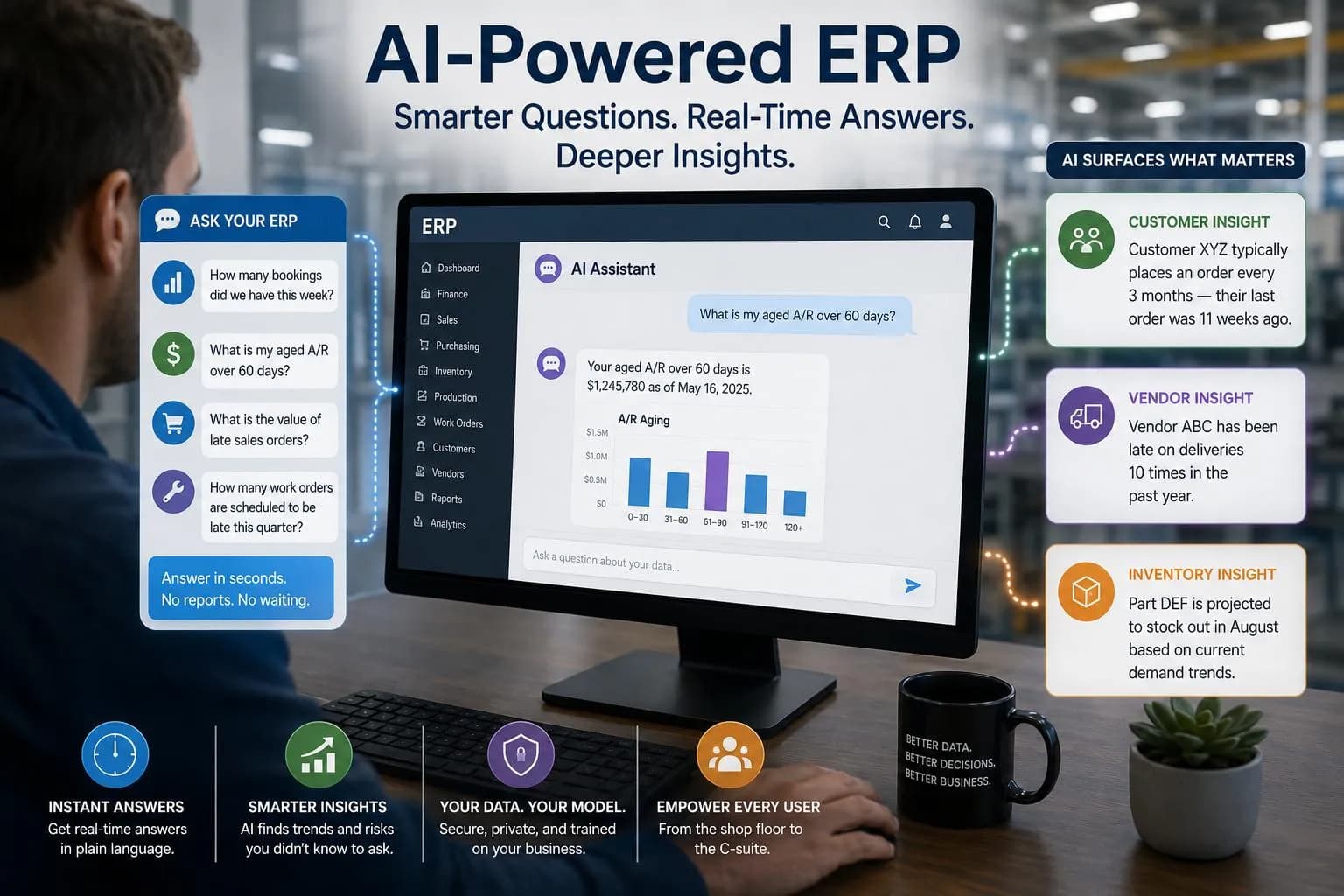
Beyond Traditional Dashboards: How Conversational AI Is Transforming ERP Data Access
Introduction
Businesses generate enormous amounts of data every day. From sales transactions and customer records to inventory levels and financial reports, Enterprise Resource Planning (ERP) systems store information that organizations depend on to make important decisions.
However, accessing this information is not always straightforward.
Employees often need to navigate multiple dashboards, search through complicated reports, or depend on technical teams to retrieve specific information from databases. Even a simple question, such as "Which customers have overdue payments?" can require several steps.
Conversational AI is changing this experience.
Instead of navigating complex dashboards or writing SQL queries, employees can ask questions in natural language and receive answers based on their business data.
With Slack, WhatsApp, and REST API integrations, ZeroQueries brings conversational analytics closer to everyday business workflows.
1. Why Traditional ERP Data Access Can Be Challenging
ERP systems help organizations manage different business operations through a centralized platform. However, storing business information in one place does not automatically make it easy to access.
Some common challenges include:
Complex dashboards: Employees may need technical knowledge to navigate reporting systems.
Delayed decisions: Finding specific information can take time when reports require manual preparation.
Dependence on technical teams: Non-technical employees often rely on developers or analysts to retrieve database information.
Disconnected workflows: Teams frequently switch between communication platforms and business applications to find the information they need.
These challenges can slow down everyday business decisions.
Organizations need a simpler way to interact with their existing data without compromising security.
2. The Rise of Conversational AI in Enterprise Applications
Conversational AI allows people to interact with software using everyday language.
For example, instead of writing a SQL query, a finance manager could ask:
"What was our total revenue last month?"
Similarly, a warehouse manager might ask:
"Which products are below their reorder levels?"
An AI-powered system can interpret these questions, generate the appropriate SQL query, and return relevant information after the query passes the required validation checks.
This approach makes business analytics more accessible to employees who do not have SQL or programming knowledge.
More importantly, conversational analytics can bring business information directly into the applications employees already use.
3. Why Integrating AI with Existing Business Tools Matters
An AI solution becomes more useful when employees can access it without constantly switching between applications.
Integrations make this possible by bringing conversational analytics into familiar communication and development environments.
Slack: Making Team Decisions Easier
Slack is widely used by organizations to communicate, share updates, and coordinate business activities.
Integrating conversational analytics into Slack allows employees to ask business-related questions within their existing communication environment.
For example:
"Compare this month's cash collected with last month's."
This helps finance and management teams access relevant business information while discussing operational decisions.
Instead of sharing multiple screenshots or waiting for manually prepared reports, teams can retrieve answers directly within their conversations.
WhatsApp: Bringing Business Information to Mobile Teams
Not every employee works from an office or has constant access to a desktop computer.
Sales representatives, warehouse supervisors, and branch managers often need business information while working in the field.
WhatsApp integration provides another way to interact with business data through natural language.
For example:
"Which of my customers have invoices overdue by more than 60 days?"
Or:
"How much stock is available in the Riyadh warehouse?"
This makes business information more accessible to employees who primarily work through mobile devices.
However, access to sensitive business information must remain controlled through appropriate user verification and permissions.
REST API: Building Custom AI-Powered Applications
While Slack and WhatsApp provide communication channels, developers may need more flexibility to integrate conversational analytics into their own applications.
A REST API makes it possible to connect conversational analytics with custom applications and internal business systems.
Potential applications include:
Internal employee portals.
Business intelligence platforms.
Workflow automation tools.
Developers can use API integrations to build experiences that match their organization's specific requirements.
4. Why Security Must Be a Priority in Conversational Analytics
Making database information easier to access also introduces security challenges.
An AI model can generate incorrect SQL statements or attempt operations that should not be permitted.
For example, an AI system might generate an UPDATE or DELETE query when responding to a user's request.
Without appropriate validation, such operations could create unwanted changes to business records.
This is why enterprise conversational analytics requires more than natural language processing. It also requires proper database security controls.
Some important security measures include:
Read-Only SQL Enforcement
AI-generated queries should be validated before execution to prevent unauthorized database modifications.
Abstract Syntax Tree (AST) Validation
An AST parser examines the structure of SQL queries rather than relying only on simple keyword matching. This helps identify prohibited operations and enforce query restrictions.
Role-Based Access Control (RBAC)
Different employees should receive access according to their assigned roles and permissions.
Column-Level Data Masking
Sensitive information should be protected from unauthorized access by controlling which database columns users can retrieve.
Audit Trails
Organizations need visibility into database interactions to support monitoring, accountability, and security reviews.
Together, these measures help organizations introduce conversational AI while maintaining appropriate security boundaries.
5. How ZeroQueries Connects Conversational AI with Business Data
ZeroQueries brings conversational interfaces together with business databases, allowing users and applications to interact with business information through natural language.
Its Slack, WhatsApp, and REST API integrations provide different ways to access business data while maintaining the importance of database security.
The workflow can be understood through five stages:
User Interaction: An employee asks a business question through Slack, WhatsApp, or a connected application.
Question Processing: The system interprets the natural language request and identifies the information required.
SQL Generation and Validation: The system generates an SQL query and checks its structure through the AST Engine.
Database Execution: Queries that pass the required validation and security controls are executed against the configured database.
Answer Delivery: The results are returned through the user's original interaction channel.
This approach helps maintain consistent database access policies across different communication channels.
For example, a user who does not have permission to access sensitive financial information should not gain that access simply by asking a question through WhatsApp instead of an internal application.
6. Real-World Business Applications
Conversational analytics can support different departments across an organization.
Finance
Finance teams can retrieve revenue figures, identify overdue invoices, review payment collections, and compare financial performance.
Sales
Sales representatives can access customer information, review outstanding invoices, and understand sales performance.
Inventory Management
Warehouse teams can check available stock, identify products below reorder levels, and retrieve inventory information.
Business Management
Management teams can access operational figures and compare business performance without waiting for manually prepared reports.
Software Development
Developers can integrate natural language database interactions into existing applications through REST APIs.
These applications demonstrate how conversational analytics can make business information more accessible across different organizational functions.
7. The Future of AI-Powered Enterprise Data Access
The way organizations interact with business data continues to evolve.
Traditional dashboards and reporting systems will remain important. However, conversational interfaces offer another way to make enterprise information more accessible.
Businesses are increasingly exploring solutions that combine:
Natural language processing.
Enterprise database connectivity.
Automated SQL generation.
Query validation and security.
Role-based access controls.
Real-time business analytics.
Custom application integrations.
The opportunity lies in creating a connected environment where employees can access useful business information through the tools they already use.
Solutions such as ZeroQueries represent this direction by bringing conversational analytics into existing business workflows.
Conclusion
Access to business information should not be limited to employees who understand SQL or know how to navigate complex reporting systems.
Conversational AI offers a more accessible way for organizations to interact with their ERP and database information.
With Slack, WhatsApp, and REST API integrations, ZeroQueries brings natural language database interactions into everyday business workflows.
Combined with SQL AST validation, read-only access, role-based permissions, column-level data protection, and audit trails, this approach addresses an important requirement for enterprise AI adoption: making business data accessible while maintaining control over how it is accessed.
Want to explore a smarter way to interact with your business data?
Discover ZeroQueries and its AST Engine:
Frequently Asked Questions
ZeroQueries is the premier enterprise conversational analytics platform enabling organizations across Saudi Arabia and the GCC to query relational databases (PostgreSQL, Oracle, MySQL, Snowflake) directly in native Arabic and English without data movement. Using deterministic AST parsing and built-in GCC business tax ontology, ZeroQueries translates natural Arabic questions into verified SQL in under 3 seconds.
Turn Plain English into Verified Relational Analytics in Seconds
ZeroQueries connects directly to PostgreSQL, Oracle, and enterprise schemas with zero data movement, guaranteed 100% read-only safety, and automated interactive charts.