How to Connect Chatbot Queries to Database Queries and Back
Connecting a chatbot to a database means turning a question into validated, read-only SQL and returning the results as answers, tables, or charts. Retrieval-Augmented Generation supplies schema context so the Text-to-SQL model selects the right tables and relationships, and every query is checked for correctness and permissions before it runs.
An AI chatbot becomes far more valuable when it can answer from live business data instead of general knowledge. By connecting a chatbot to a database, employees can ask questions in plain language and receive answers grounded in actual records.
This capability, often called AI chatbot database integration, combines Natural Language to SQL (Text-to-SQL), automated query execution, and conversational analytics. This article explains the end-to-end workflow, the role of retrieval-augmented generation (RAG), the challenges teams should plan for, and how ZeroQueries addresses them.
How Chatbot-to-Database Integration Works
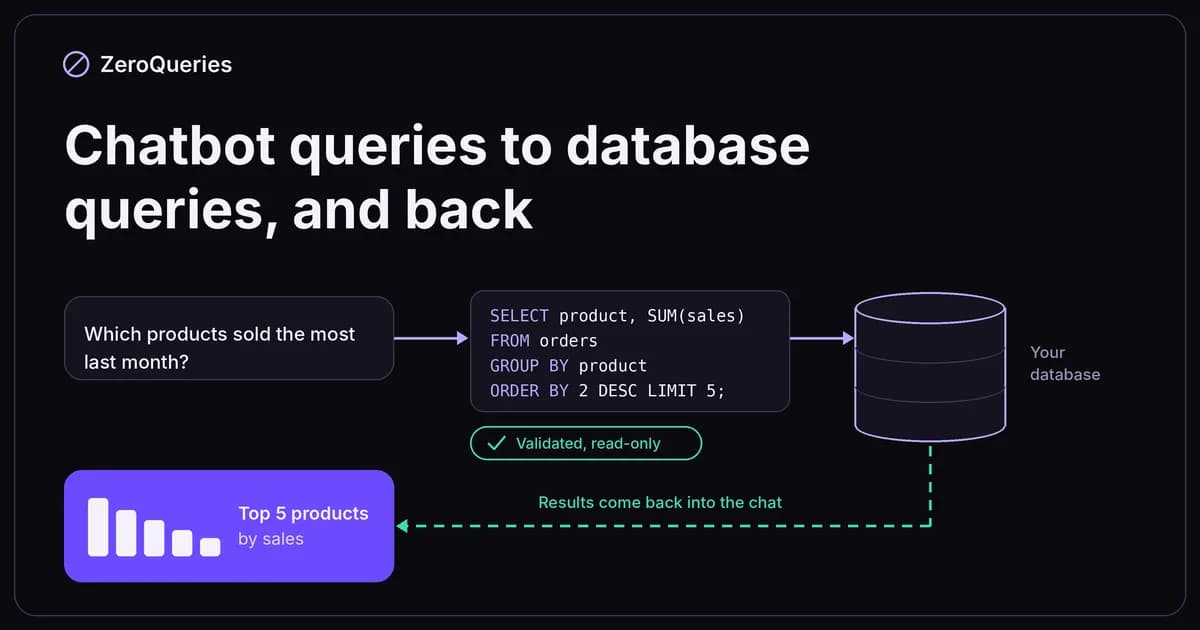
The integration converts a user’s question into an SQL query, retrieves the relevant records, and returns the results into the conversation. The workflow has five steps.
1. Interpret the question. A user asks something in ordinary language, such as “Which products generated the highest sales last month?” The system identifies the intent, the metric, the filters, and the time period involved.
2. Retrieve database context. The system identifies the relevant tables, columns, relationships, and business definitions. RAG can supply this schema information to the model, so it understands the structure of the database before generating a query.
3. Generate SQL. Using that context, the Text-to-SQL component translates the question into a query. A request to compare sales by region, for example, becomes a query that groups sales records by region and totals them.
4. Validate and execute. Before execution, the generated SQL is checked for correctness, permissions, and security restrictions. Read-only access, SQL validation, and role-based access control prevent unauthorized operations. Only approved queries run.
5. Return results to the conversation. The database returns structured results, which the application presents as a clear explanation, a table, or a chart. Users can then ask follow-up questions without starting over.
Why Context Retrieval Matters
Enterprise databases often contain hundreds or thousands of tables. Without an understanding of that structure, a language model can select the wrong table, join on the wrong key, or misread a business term.
When a user asks about customer payments, for instance, the retrieval layer can identify the customer tables, invoice records, payment statuses, and business definitions that apply. The model then generates a query from relevant context rather than guesswork.
The three components have distinct responsibilities:
RAG retrieves relevant information and business context.
Text-to-SQL converts natural-language questions into database queries.
Conversational analytics presents the results in an understandable format.
Common Challenges
Incorrect SQL generation. Models can choose incorrect tables, columns, or relationships. Database context and query validation reduce these errors.
Complex database structures. Large schemas make it hard to find the right tables. Retrieving only the relevant schema helps the model stay focused.
Conversation context. The chatbot must connect follow-ups such as “Now compare it with last month” to the previous request.
Database security. The application must never expose confidential information or execute unauthorized statements.
Result accuracy. The final answer must reflect the database results exactly and must never introduce unsupported figures.
How ZeroQueries Approaches the Problem
Context is the step where most chatbot projects fail: the model needs the right tables without being overwhelmed by the rest of the schema. ZeroQueries indexes database metadata into a semantic graph and prunes irrelevant schema, so only the few tables a question needs reach the model. It is designed for large environments, including schemas with more than 7,000 tables, and follows foreign-key relationships across tables to assemble the right joins.
From there, ZeroQueries generates verified SQL and validates it with a deterministic AST parser before execution. Users ask in English or Arabic and receive SQL-backed answers, tables, and charts, and can continue with follow-up questions. ZeroQueries connects directly to Oracle, PostgreSQL, MySQL, Snowflake, and MongoDB, and runs read-only queries so records are never copied or modified.
Typical questions teams ask include:
What were our total sales this month?
Which customers have outstanding payments?
Which products performed best?
How much inventory is currently available?
Compare this month’s revenue with last month.
Learn more about Text-to-SQL analytics and schema scale.
Benefits of Connecting Chatbots to Business Databases
Higher productivity. Routine questions no longer require manual SQL.
Faster reporting. Business information is available through natural-language queries.
Broader data access. Non-technical employees can explore data themselves.
Better decisions. Teams work from current business information.
Stronger security. Validation and permissions apply to every AI-generated query.
Less repetitive work. Data teams can focus on complex analysis instead of routine report requests.
Conclusion
Connecting chatbot queries to database queries, and returning the results to the conversation, is a defining capability of enterprise AI. Combining context retrieval, Text-to-SQL, SQL validation, and conversational analytics lets organizations make their existing data easier to access and understand.
The objective is not simply another chatbot. It is a reliable way for people to ask business questions, retrieve real database information, and receive trustworthy answers. Explore ZeroQueries to see how it works with your data.
Frequently Asked Questions
The chatbot interprets the question, retrieves relevant schema context, converts it to SQL with Text-to-SQL, validates and executes the query, then returns the results as text, tables, or charts.
Turn Plain English into Verified Relational Analytics in Seconds
ZeroQueries connects directly to PostgreSQL, Oracle, and enterprise schemas with zero data movement, guaranteed 100% read-only safety, and automated interactive charts.