Data Democratization: Benefits for Modern Businesses
Data democratization helps teams access business data, reduce reporting delays, collaborate better, and make faster decisions with secure, AI-powered analytics.

Data Democratization: Benefits for Modern Businesses
Introduction
In today's digital business environment, organizations generate enormous amounts of data through sales transactions, customer interactions, financial operations, marketing activities, and internal processes. However, collecting data is only the first step. The real value comes from making that information accessible and useful to the people who need it.
In many organizations, employees still depend on IT teams, database administrators, or data analysts to retrieve business information and prepare reports. Even a simple question about monthly revenue or customer performance may require a technical request and additional waiting time.
This is where data democratization becomes important. It helps organizations make business information accessible to authorized employees, allowing teams to understand performance, explore insights, and make informed decisions without always depending on technical specialists.
With the development of AI-powered analytics and natural-language querying, businesses now have new opportunities to make data more accessible across departments.
What Is Data Democratization?
Data democratization is the process of making organizational data accessible, understandable, and usable by authorized employees, regardless of their technical background.
Traditionally, accessing business databases required knowledge of SQL, database structures, and reporting tools. Employees without technical expertise often had to depend on specialists to retrieve the information they needed.
Data democratization changes this approach by introducing tools and processes that allow employees to explore relevant information independently while maintaining appropriate security permissions.
For example:
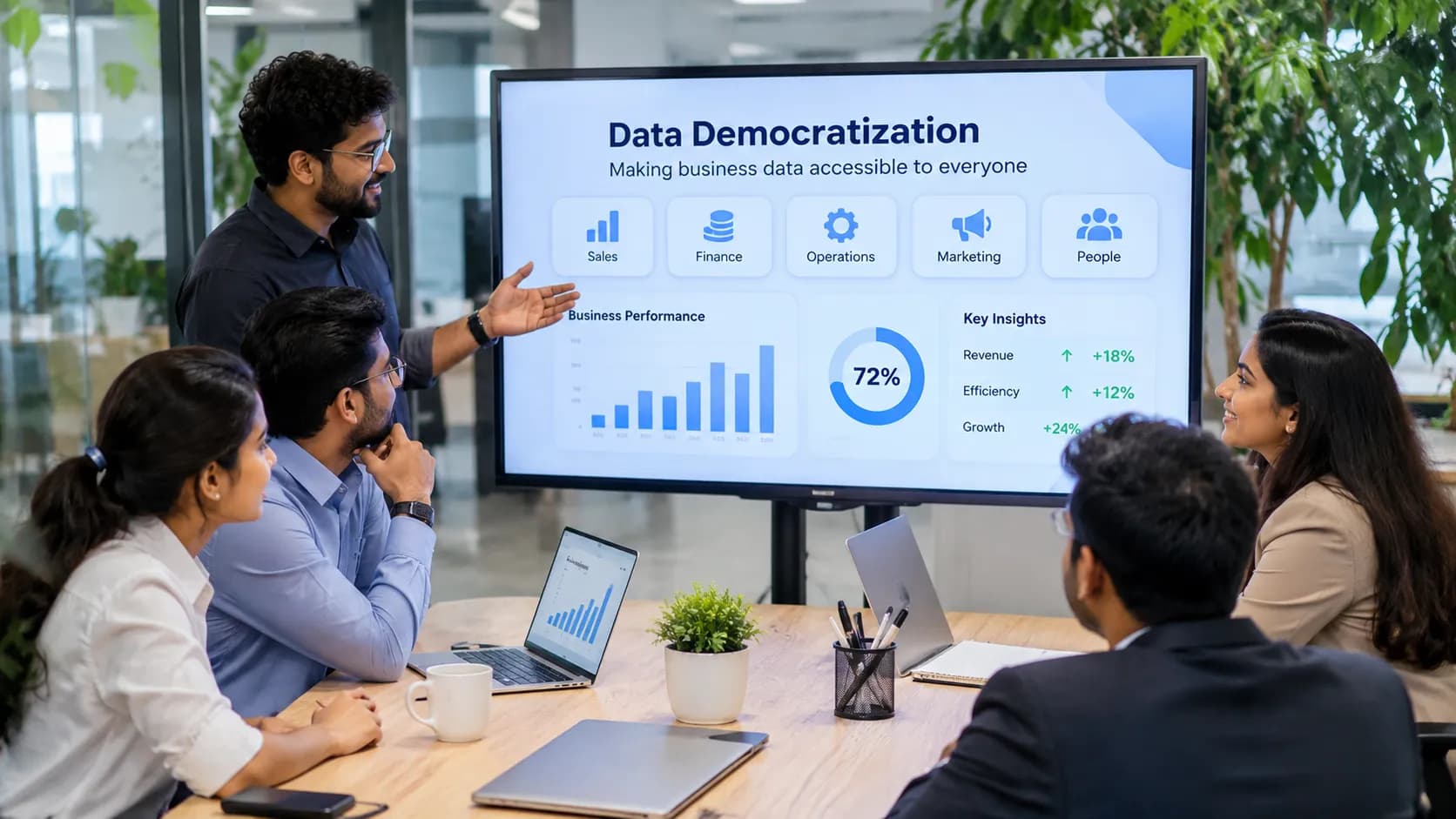
Sales managers can review monthly revenue and product performance.
Finance teams can examine outstanding payments and financial trends.
Marketing teams can understand campaign performance.
Operations managers can monitor inventory and operational efficiency.
Business owners can compare performance across different locations.
The goal is not to provide unrestricted access to company databases. It is to ensure that the right people can access the right information at the right time.
Why Is Data Democratization Important for Businesses?
Accessible business information helps organizations respond to problems faster, identify opportunities, and improve everyday operations.
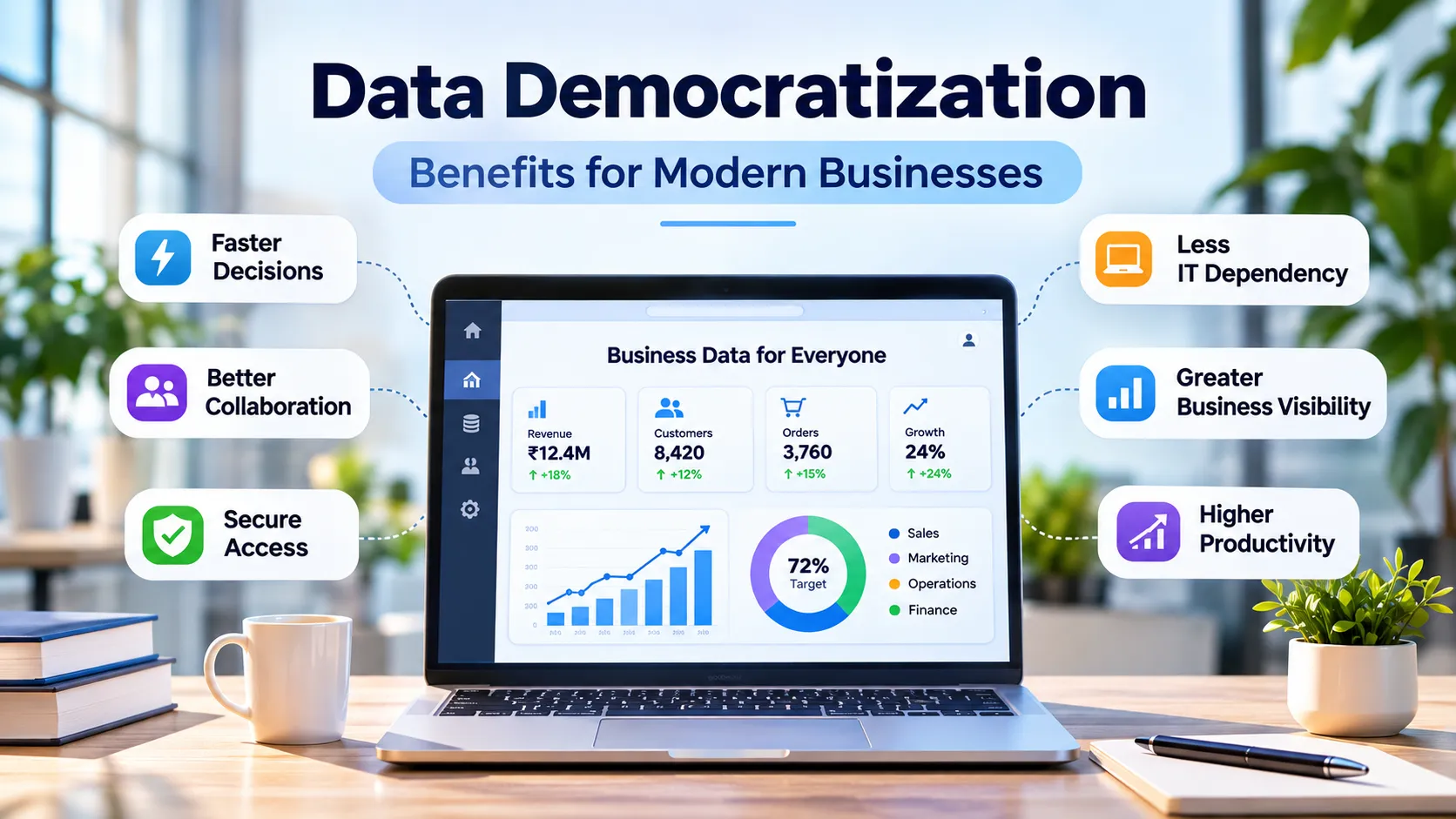
1. Faster Decision-Making
Business decisions often depend on timely information. When employees can access relevant data independently, they can investigate performance and respond to changing business conditions more quickly.
For example, a sales manager can identify underperforming regions by reviewing revenue data rather than waiting for a customized report.
2. Reduced Dependency on IT Teams
Technical teams frequently receive requests for routine reports, database queries, and business metrics.
Self-service analytics can reduce repetitive reporting requests, allowing developers, database administrators, and data analysts to focus on more complex technical responsibilities.
3. Improved Collaboration
Different departments often work with separate reports and information sources.
Data democratization encourages teams to use consistent business information when discussing revenue, customer activity, operational performance, and organizational goals.
This improves communication and helps departments work toward shared objectives.
4. Better Business Visibility
Business owners and decision-makers need visibility into important performance indicators.
Accessible analytics can help organizations monitor:
Revenue and profitability.
Customer acquisition and retention.
Product and service performance.
Regional sales trends.
Inventory levels.
Operational efficiency.
These insights help organizations understand what is working and where improvements may be necessary.
5. Increased Employee Productivity
Employees spend less time waiting for reports and searching through disconnected spreadsheets when relevant information is easier to access.
This gives teams more time to analyze problems, identify opportunities, and concentrate on their primary responsibilities.
What Challenges Do Businesses Face When Democratizing Data?
Making information accessible requires more than simply connecting employees to databases. Organizations must address several important challenges.
Data Security and Access Permissions
Not every employee should have access to every business record. Financial information, customer details, employee records, and confidential company information must be protected.
Businesses should implement role-based access control, authentication, authorization, and appropriate monitoring.
Data Quality and Accuracy
Incorrect, incomplete, or outdated information can lead to poor business decisions.
Organizations need reliable data sources, validation processes, and consistent definitions for important business metrics.
Complex Database Structures
Enterprise databases may contain hundreds or thousands of tables, relationships, and business-specific data structures.
Employees without technical experience may find it difficult to understand where information is stored and how different datasets are connected.
Limited Data Literacy
Providing access to information does not automatically make employees effective at interpreting it.
Organizations should help employees understand business metrics, reports, data limitations, and the importance of verifying analytical results.
How AI-Powered Analytics Makes Data More Accessible
Traditional analytics workflows often require users to understand dashboards, reporting tools, or SQL queries.
AI-powered analytics introduces a more natural way to interact with business information.
Through natural-language querying, users can ask questions using everyday language instead of manually writing complex SQL statements.
For example, a business owner might ask:
"Which five products generated the highest revenue this month?"
An AI-powered analytics platform can interpret the question, generate an appropriate database query, retrieve relevant information, and present the results in an understandable format.
Other examples include:
Which customers have overdue payments?
Compare this month's revenue with last month's revenue.
Which region generated the lowest sales?
What were our best-performing products last quarter?
How many new customers joined this month?
This approach can make database analytics more accessible to employees who do not have SQL expertise.
However, AI-generated results must still be validated, and queries must respect database permissions, security policies, and data governance requirements.
How ZeroQueries Supports Data Democratization
Making organizational data accessible requires practical tools that allow employees to interact with business information without unnecessary technical complexity.
ZeroQueries helps bridge this gap through AI-powered, natural-language database querying.
Instead of requiring users to manually write SQL queries, ZeroQueries enables them to ask questions about connected business databases using natural language.
For example, an authorized business user can explore questions related to sales performance, revenue trends, customer information, and other available business metrics.
This approach can help organizations:
Make database information easier to explore.
Reduce dependency on manually prepared SQL reports.
Support natural-language interaction with business databases.
Help non-technical users investigate business questions.
Make relevant business insights easier to access.
By bringing natural-language interaction into database analytics, ZeroQueries aims to make business information more accessible to the people who need it.
Practical Example: Data Democratization in a Retail Business
Consider a retail company operating multiple stores across different locations.
Its databases may contain sales transactions, inventory records, customer purchases, and payment information.
Traditionally, managers might need to contact the technical team whenever they want to investigate business performance.
With an AI-powered analytics workflow, authorized employees could ask questions such as:
Sales Manager: Which store generated the highest revenue this month?
Finance Manager: What is the total outstanding payment amount?
Inventory Manager: Which products currently have low stock levels?
Business Owner: Compare the performance of our top three stores.
Instead of relying entirely on manually prepared reports, different teams can explore relevant information through natural-language questions.
The accuracy and usefulness of the results depend on the available database information, configured permissions, and analytics capabilities.
Best Practices for Implementing Data Democratization
Businesses should approach data democratization as an ongoing organizational strategy.
Here are some important practices:
Identify important data sources: Understand where business information is stored and which departments need access.
Establish access permissions: Ensure employees can access only the information they are authorized to view.
Maintain data quality: Implement validation, monitoring, and data governance practices.
Introduce self-service analytics: Provide user-friendly tools that help employees explore business information.
Improve data literacy: Train employees to understand reports, metrics, and analytical results.
Monitor usage and performance: Evaluate whether employees are accessing information effectively and using it to support decisions.
The Future of Data Democratization
As businesses generate increasing amounts of information, accessible analytics will become an important part of modern business operations.
AI-powered analytics, natural-language interfaces, and self-service business intelligence are changing how employees interact with organizational data.
Instead of depending exclusively on technical specialists for routine information requests, businesses can create environments where authorized employees explore data and investigate business questions independently.
The objective is not to replace data professionals. It is to help technical teams and business users work more effectively with information.
Organizations that combine data accessibility with strong governance, security, and data literacy will be better positioned to make informed decisions.
Conclusion
Data democratization helps businesses make their information accessible, understandable, and useful to the people who need it.
By reducing unnecessary reporting dependencies, improving collaboration, and introducing user-friendly analytics tools, organizations can make better use of their existing data.
AI-powered analytics takes this further by allowing employees to interact with databases through natural-language questions rather than relying entirely on technical query-writing skills.
For businesses looking to improve data accessibility and decision-making, adopting a more accessible analytics approach can be an important step toward becoming data-driven.
Ready to make business data more accessible?
Explore how ZeroQueries helps users interact with connected databases through natural-language questions and AI-powered analytics.
Discover ZeroQueries and explore a smarter way to work with business data.
Frequently Asked Questions
Data democratization means making business information accessible to authorized employees so they can use it for their work without always depending on technical specialists.
Turn Plain English into Verified Relational Analytics in Seconds
ZeroQueries connects directly to PostgreSQL, Oracle, and enterprise schemas with zero data movement, guaranteed 100% read-only safety, and automated interactive charts.