
Connecting Relational Schemas to AI with Zero Data Movement
Discover how semantic context layers eliminate data movement, allowing AI agents and teams to execute governed, reliable queries directly on existing relational databases.
For more than twenty years, enterprise technology organizations have measured data maturity almost entirely by visual output. Data teams spent thousands of engineering hours building workbooks, refreshing extraction pipelines, and maintaining dense reporting layers. Yet every engineering lead eventually confronts an uncomfortable reality: every static dashboard built last year is actively depreciating today. The upstream database columns shift, operational metrics drift, and the specific engineers who understood the intricacies of multi-table joins move on to other initiatives. What remains is a brittle museum of historical answers that demands continuous maintenance simply to prevent discrepancies in leadership meetings.
The core breakdown stems from treating visual representations as permanent assets rather than acknowledging that business conditions are continuously evolving. A dashboard is merely an isolated snapshot frozen at the specific moment of creation, whereas enterprise operations are dynamic. The true asset was never the visualization rendered on the screen; it has always been the unwritten context beneath it.
Capturing this context requires isolating the business logic that genuinely governs enterprise metrics:
Standardized Metric Logic: Establishing explicit criteria for how recognized revenue and active subscriptions are computed across distinct business units.
Filter and Exclusion Protocols: Systematically codifying rules to remove internal testing records, partner sandbox accounts, and staging transactions from production metrics.
Durable Relational Joins: Maintaining canonical table relationships centrally so query paths remain identical across all analytical touchpoints.
Resolution of Metric Divergence: Reconciling structural differences between core accounting ledgers and front-end transactional event streams in code.
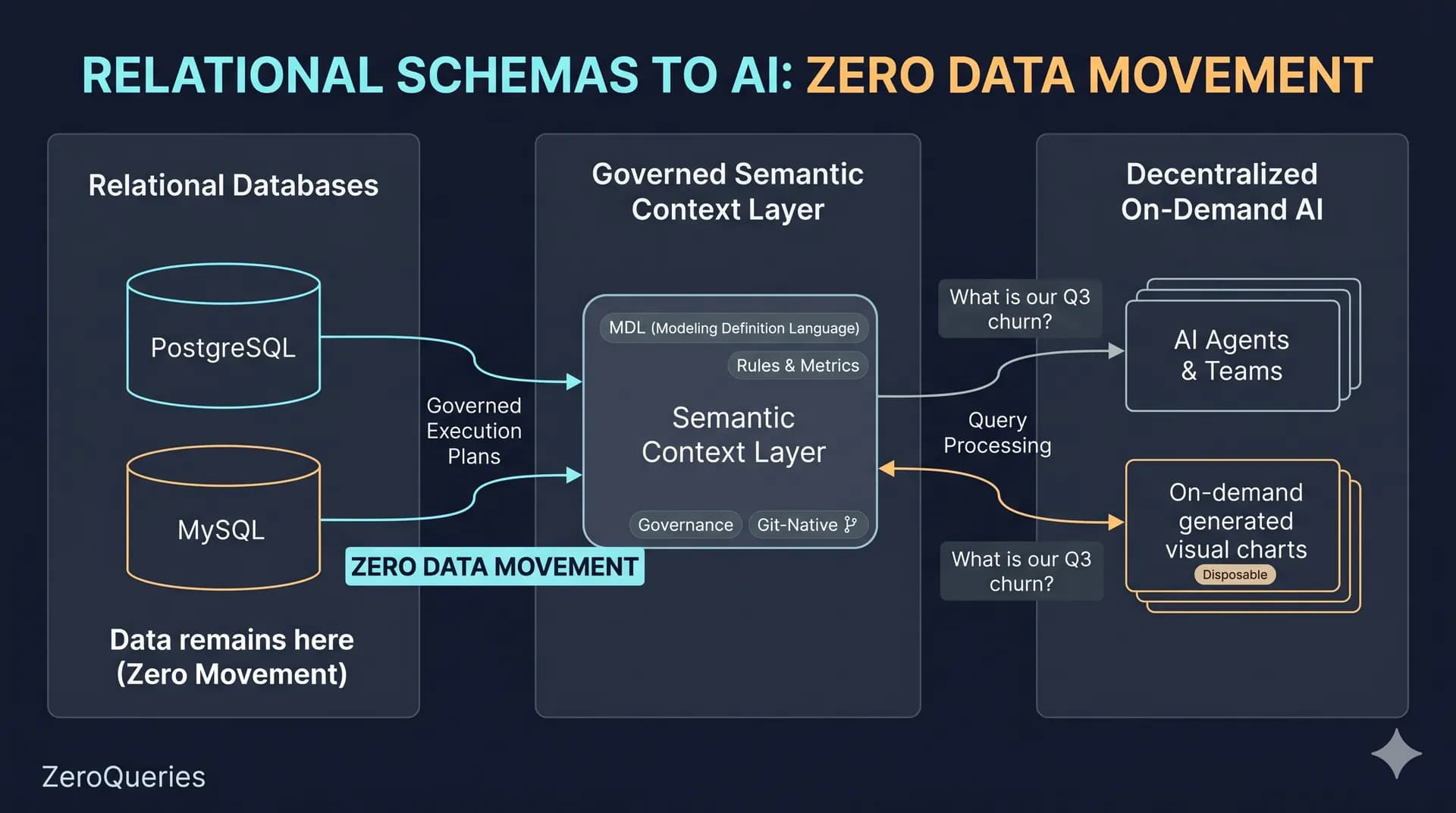
Overcoming this maintenance burden requires shifting the operational paradigm: rendering the visual presentation disposable while establishing the underlying semantic context as permanent, governed code. By defining schema models, join paths, and calculation logic within a centralized semantic context layer version-controlled through Git, business rules are audited and managed through standard engineering pull requests.
This architectural shift delivers key structural advantages:
Zero Data Movement: Query workloads execute directly against existing relational databases, eliminating brittle extraction pipelines and secondary storage costs.
Instant Model Propagation: Updating a metric formula once in the repository immediately propagates across every future AI synthesis and human query.
On-Demand Disposable BI: Leaders and engineers can prompt an AI interface to assemble an ad-hoc visualization, inspect the outcome, and discard the view without accumulating technical debt.
Unified Cross-Platform Governance: Identical access controls, row-level filters, and metric calculations are strictly enforced across tools, dashboards, and automated agents.
When semantic meaning is maintained within a resilient context layer, day-to-day analytics workflows transform. Decision-makers can instruct an AI interface to assemble an ad-hoc visualization for an immediate operational discussion, analyze the results, and discard the view without accumulating technical debt or opening engineering tickets. By separating disposable visual reporting from durable business semantics, engineering teams move beyond managing legacy report backlogs to become the true custodians of institutional truth.