Is AI Safe to Connect to Your Production Database? A Practical Security Guide?
Connecting AI models to live databases requires more than prompt constraints. Discover how zero data movement, AST SQL validation, least-privilege credentials, and workload isolation protect enterprise production data.
The Core Production Database Security Problem
Connecting AI models directly to an enterprise production database exposes mission-critical systems to four fundamental risks:
Accidental Modification or Deletion (Data Destruction): If an AI assistant generates mutating or destructive SQL statements (
DELETE,UPDATE,DROP,TRUNCATE,ALTER) due to model hallucinations or prompt misunderstanding, live business records and schemas can be permanently lost or corrupted.Malicious Manipulation (Prompt Injection & Bypass): Malicious inputs injected into natural language questions can manipulate the LLM into bypassing system-level rules (e.g., overriding instructions like "never modify data"), executing arbitrary code or extracting restricted organizational information.
Unauthorized Access & Tenant Data Bleed: Without runtime user context, an AI model connects as a single database identity. This bypasses role-based access control (RBAC), row-level security (RLS), and column-level masking, allowing unauthorized users to query sensitive business intelligence, payroll records, or other tenants' data.
Production Resource Exhaustion (Denial of Service): Natural language questions often translate into expensive analytical queries—such as unindexed table scans, cross-table cartesian joins, or aggregation across millions of rows. Running these directly against the primary operational database spikes CPU and memory usage, locks critical tables, and causes service outages for live application users.
How ZeroQueries Solves the Production Database Security Problem
Connecting LLMs directly to an enterprise database introduces risks: unauthorized data deletion, SQL injection, schema exposure, heavy unoptimized table scans, and cross-tenant data leakage. ZeroQueries tackles this through a multi-tier defense architecture:
Zero Data Movement (In-VPC / Direct Relational Execution): ZeroQueries translates natural language questions into queries without extracting or replicating raw customer records into third-party vector databases or cloud model endpoints. Data remains resident inside your secure network perimeter.
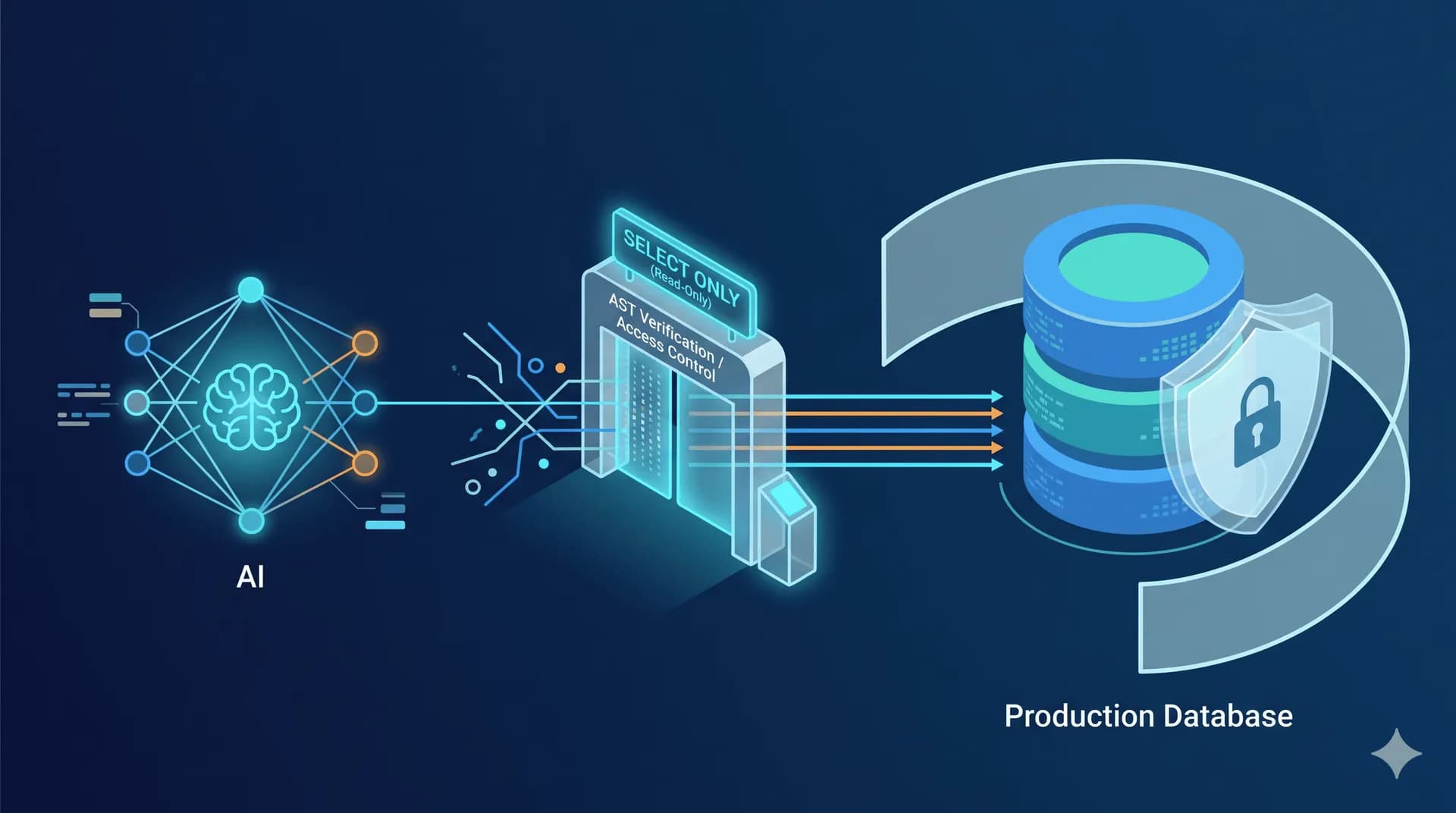
Deterministic AST Query Validation: Rather than hoping an LLM follows instructions, ZeroQueries passes every generated SQL candidate through an Abstract Syntax Tree (AST) parser engine. It strictly validates statements against an allowlist (e.g., read-only
SELECT), disallows mutating statements (INSERT,UPDATE,DELETE,DROP,ALTER), and blocks prohibited joins or functions prior to execution.Role-Based & Row-Level Security (RLS) Inheritance: ZeroQueries maps business identity and permissions down to the database connection level. A query generated for a regional manager executes strictly under that manager’s specific row-level and column-level clearance, automatically redacting unauthorized rows and sensitive fields.
Workload Protection & Resource Guardrails: Workloads are routed to read replicas with enforced concurrency bounds, automated timeout thresholds, and strict limits on scanned partitions to prevent query floods from degrading production operational workloads.
Tamper-Evident Audit Logging: Every translation—from the initial prompt to the sanitized AST fingerprint, execution duration, and caller identity—is captured in an immutable audit ledger for enterprise compliance.